The problem we kept running into
Every effort we run with frontier models starts well. Three or four chats, each loaded with context. A coding agent in one window, a strategy session in another, research in a third, drafts somewhere else.
By the end of the second week, the picture has fragmented. Each agent knows part of the work. None of them know the whole. None of them know what the others have already figured out. The team cannot point at any one place and say “this is what we currently believe.”
The agents are getting better. The fragmentation is getting worse.
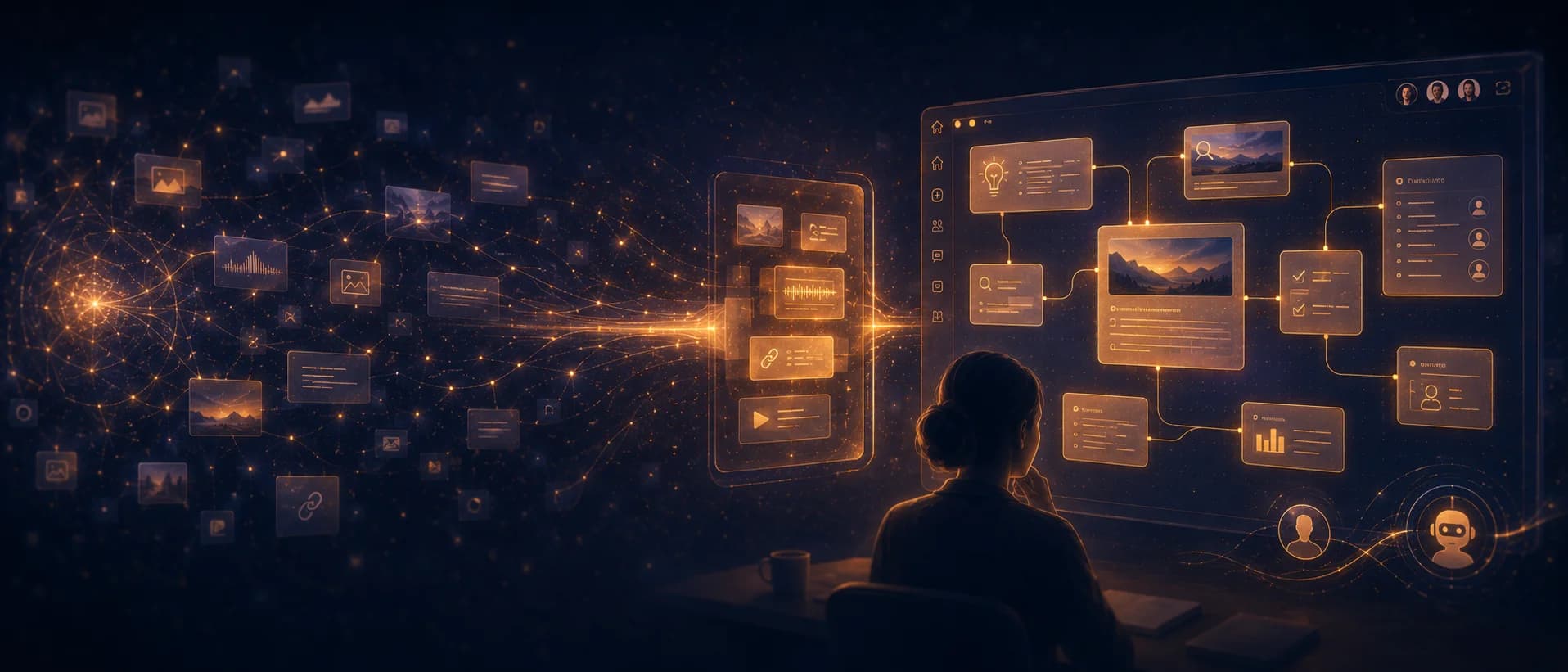
CreatorNotes started from one observation: the missing layer is not a smarter chat. It is a shared, visible workspace where the humans and the agents doing the work can both write, both read, and both keep building from the same context.
What agent memory does well
Agent memory layers have become a default choice for keeping AI assistants from starting cold. They give the agent a way to carry forward what matters: user preferences, prior decisions, recurring context, the specifics of the work, facts learned in earlier sessions. With semantic retrieval the agent does not need an exact keyword match. It can recover memories by meaning.
This is genuinely useful. A coding agent that remembers how a repository is structured, a support agent that recalls a customer's history, or a personal assistant that understands your ongoing preferences becomes much more useful over time.
Inside that envelope, agent memory is solving a real problem well:
An agent should not forget everything every time the conversation ends.
Recall is not orientation
Agent memory gives you recall. Recall helps the next conversation pick up from context the previous one already learned.
But the work needs orientation. Orientation tells you and your collaborators what the work currently knows, where the evidence sits, what was decided, what was rejected, and what is still open.
If you ask:
- · What does the team currently believe about this strategy?
- · Which evidence supports that decision?
- · What changed since last week?
- · Which proposal was rejected, and why?
- · What remains unresolved?
- · What should the next human or agent work from?
A ranked set of memory matches is not enough by itself. Those questions require a visible, shared surface, not only a retrieval layer.
The difference matters more as work shifts from one person using one assistant to groups of people working alongside multiple agents.
A product team, for example, may spend two weeks shaping a pricing change. One person drafts the initial hypothesis. A researcher adds customer interview notes. An analyst contributes usage and churn data. An agent turns the material into three possible strategies. Another agent critiques the assumptions. The team rejects one path, revises another, and approves a direction.
A memory layer can help retrieve pieces of that history later. A shared working memory system shows the state of the thinking: the current decision, the evidence that supports it, the evidence that complicates it, the discarded option and why it was dropped, the latest version of the strategy, the unresolved question still blocking the next move.
A new teammate should not have to guess what to search for. A new agent should not have to reconstruct the work from scattered retrieved memories. They should be able to enter the workspace and see what the work now knows.
What shared working memory has to be
For humans and agents to work from the same context, the memory layer has to be different in shape. It cannot only be a backend that returns relevant fragments at runtime. It has to become a working surface.
Shared by workspace, not only remembered by an agent
The unit of memory should be the workspace, not only the individual agent session. Everyone working on the same problem, including the agents they run, needs access to the same evolving context.
Open to every kind of input
The work does not live inside a single chat window. It lives across notes, meeting transcripts, imported documents, screenshots, research, decisions, drafts, customer feedback, and agent outputs. Shared working memory should accept all of it, because all of it shapes the work.
Visible to humans
A team cannot align around a memory store it cannot meaningfully read. Shared working memory needs a human-facing view: a canvas, a structured document, a graph, a workspace. Something people can sit in front of together, point at, debate, and reorganise.
Deliberate, not purely automatic
Not every fact an agent extracts should become canonical shared knowledge. Agents should suggest, draft, cluster, and surface what appears important. Humans should be able to approve, revise, reject, or supersede what becomes the accepted record. The goal is not to supervise every agent action. The goal is to preserve intentionality where it matters.
Provenanced
Shared memory without provenance becomes hard to trust. A team needs to know who added something, when it changed, what it was derived from, what it replaced, and which decision it supports. Without that history, recalled context may be convenient, but it is not reliable enough to become a shared source of truth.
Structured and relational
The work is not a flat bag of facts. Ideas support other ideas. Evidence contradicts assumptions. Decisions derive from research. Strategies supersede previous strategies. A shared working memory system should express those relationships directly. That is the difference between remembering and understanding.
Built to fight entropy
Every workspace accumulates clutter. Old ideas linger. Duplicate notes appear. Stale claims sit beside current ones. A memory layer that grows forever without shape eventually recreates the same chaos it was meant to solve. Shared working memory should help maintain itself: surface duplicates, flag stale assumptions, detect contradictions, expose gaps.
How CreatorNotes fits
CreatorNotes is being built as the shared working memory layer for humans and AI agents. Its core primitive is not a private memory store. It is a workspace that humans and agents can both read, write, inspect, and evolve together.
Workspace-scoped context
The workspace is the unit of memory. It holds the notes, decisions, research, drafts, and relationships that matter to the work. People and agents operate against that shared context rather than rebuilding their own private picture from scratch.
Human-legible structure
Notes live on a canvas. Relationships are expressed directly. Clusters of thinking form over time. The team can see not only the individual pieces of knowledge, but how those pieces fit together. Nothing is asking humans to trust that the right context exists somewhere in a hidden store.
Agent-operable by design
Agents can use CreatorNotes as a tool through a first-class CLI. They create notes, link ideas, retrieve context, cluster related material, extract decisions, and help reorganise the workspace as it evolves. A traditional document is readable by a person but rigid for an agent. A retrieval store is useful to an agent but invisible to a team. CreatorNotes sits in the middle.
Deliberate canon
Agents propose. Humans decide what becomes accepted shared context. A useful shared memory system cannot treat every generated fragment as equally authoritative. CreatorNotes is built around a more deliberate model: agent assistance without surrendering the shape of the workspace. The user is curating, not babysitting.
Provenance and change history
Versions are first-class. Change descriptions are required, not optional. A note can show what it came from, what it supports, what it supersedes, and how it changed over time. The workspace becomes a traceable record of how the work learned.
Structured, living memory
Notes can take on roles: insight, decision, strategy, metric, question, source, task. Relationships describe how they interact: supports, contradicts, derived-from, references, supersedes. The workspace's memory becomes more coherent as it grows, not less.
What we are betting on
We are not trying to win the chat surface. The frontier models already own that. CreatorNotes is building the layer beneath it.
Chat is good for generation. Canvas is good for alignment. CreatorNotes is built to win at the alignment layer.
The moat is not the model. It is the workspace, the relationship graph, the provenance, the visible structure, and the workflows that stay useful regardless of which frontier model the user happens to be running this week.
As more of this shifts to a mix of humans and agents collaborating in the same workspace, the layer that holds the shared, durable context becomes the most valuable one. That is the layer we are building.
The difference
Agent memory helps agents remember.
CreatorNotes helps humans and agents build shared understanding.
Agent memory answers:
What should this agent recall when it acts again?
CreatorNotes answers:
What does this work now know, how do we know it, what changed, and what should humans and agents safely work from next?
These are not the same problem. Agent memory is becoming essential. As assistants turn into durable collaborators, they need continuity. But as collaboration becomes multi-human and multi-agent, continuity alone will not be enough. Teams will need a shared place where context can be built, inspected, trusted, and evolved together.
That is where shared working memory begins. That is why CreatorNotes now exists.
Start with one workspace.
Create a workspace, point your agents at it, and let the context you keep losing start landing somewhere it can be reused.
Sign in to try it